No. MUS2026-056
Sayid, a Saharan child's toy
Saharan Algeria · North Africa
Play / practical
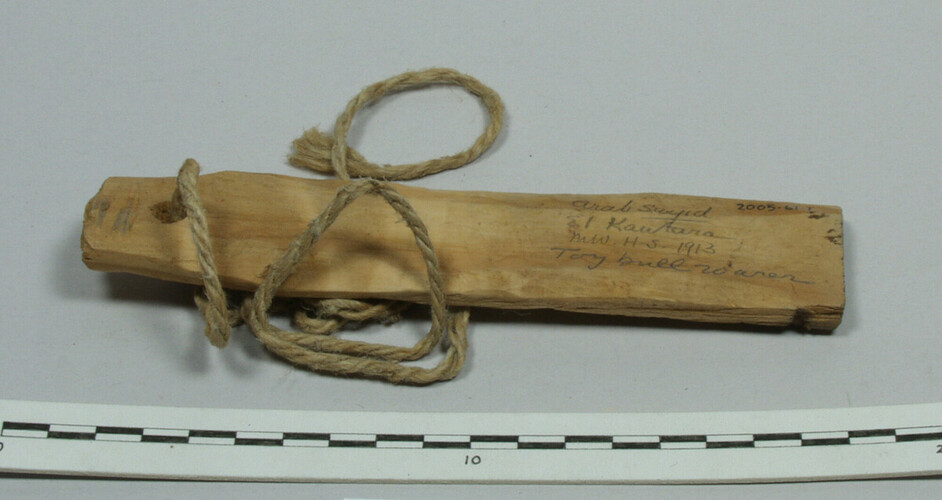
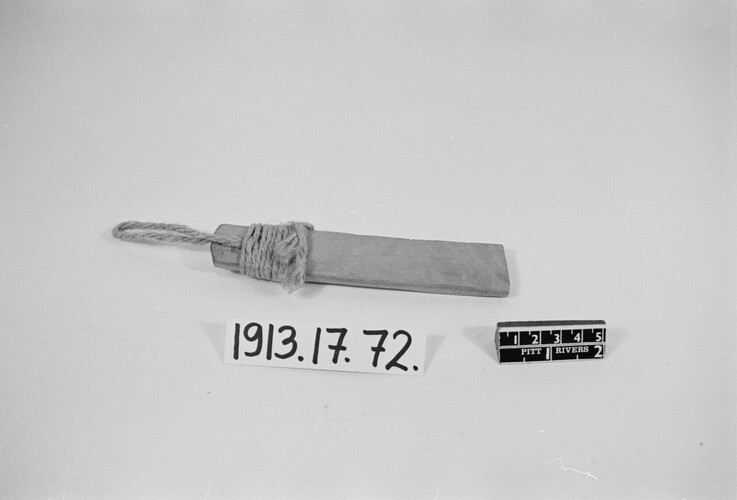
SAYID
Source term: bull-roarer
"Sayid" is the local name recorded by Hilton-Simpson for this El Kantara bullroarer; "El Kantara" is the gorge-town gateway between the Algerian high plains and the Sahara, on the edge of the Aures (Shawia Berber) country.
A wooden bullroarer collected at El Kantara, on the desert edge below the Aures, by Melville Hilton-Simpson in the winter of 1912-13 and now in the Pitt Rivers Museum. It is a plaything — the local "sayid," a perforated wooden slat whirled on a fibre cord — and it came home among Hilton-Simpson's other Algerian toys and games. No men's cult, weather rite, or secrecy attaches to it; on the Saharan rim the roarer surfaces simply as a noisemaker in a child's hand.
Particulars
- Object
- Bull-roarer of the Arab (Saharan), Pitt Rivers Museum, Oxford (acc. 2005.61.1). Five more sayid from El Kantara are in the same museum, 1913.17.72–76, none longer than a hand's span at 10.9 to 15.3 centimetres and running from broad paddles to ribbons barely two centimetres across.
- Function
- A child's plaything: the sayid is classed with Hilton-Simpson's Algerian toy-and-game material, with no rite, weather magic, or secrecy attached.
Source
Pitt Rivers Museum, Oxford, acc. 2005.61.1; field-collected by Melville William Hilton-Simpson at El Kantara, Algeria, winter 1912-13 (local name "sayid")