No. GEISER1978-001
Swiss firlifurli / Schnurre, Ticino name
Ticino · Switzerland-wide folk tradition · Central Europe
Play / practical
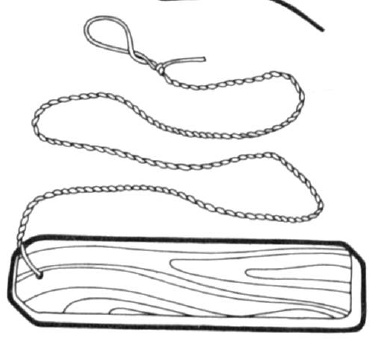
Schnurre / fiferlet / firlifurli
Source term: Schwirrholz
Schnurre, from German schnurren 'to whirr'; firlifurli is the Ticino name and fiferlet another Swiss form. Schwirrholz, 'whirring wood', is the German word for the bullroarer.
A children's toy found everywhere in Switzerland — so Brigitte Geiser's survey of Swiss folk instruments records it: a wooden shingle on a cord, swung over the head until it hummed, the pitch climbing and falling with the speed of the swing. German Switzerland called it the Schnurre; in Ticino it was the firlifurli. And the toy is old — archaeological finds attest it in Switzerland since the fourteenth century, six hundred years of the same simple rig.
Eine Schindel an einer Schnur wird vom Spieler über dem Kopf durch die Luft gewirbelt.
A shingle on a cord is whirled through the air over the player's head.
Brigitte Geiser, 'Die Volksmusikinstrumente der Schweiz' (1978), p. 78.
Particulars
- Object
- A wooden shingle tied at one end to a cord and whirled over the player's head.
- Function
- Geiser classifies it as a whirled aerophone and calls it a children's toy widespread across Switzerland; pitch varies with rotation speed, and archaeological finds attest the instrument in Switzerland since the 14th century.
Source
Brigitte Geiser, Die Volksmusikinstrumente der Schweiz (1978), p. 78