Atlas Essay —
The Bullroarer at Rest
Alentejo · Évora · Portimão · Saltstraumen · Matjes River · Chahai
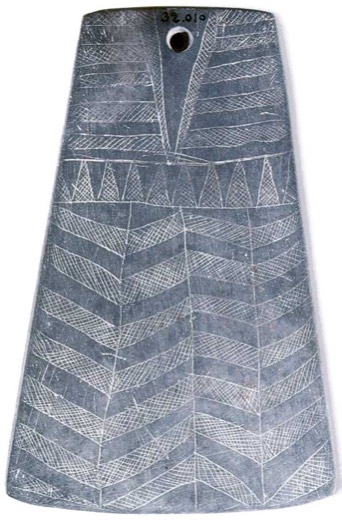
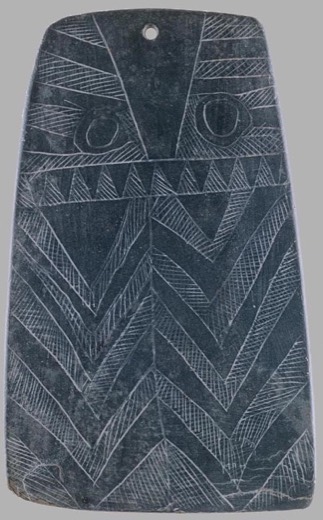
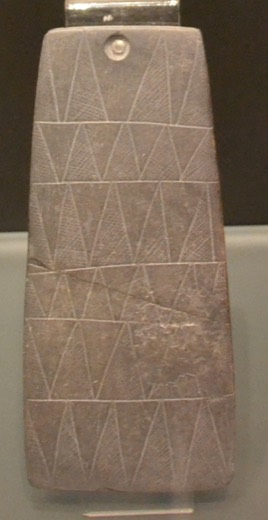
Five thousand years ago, in the megalithic tombs of southwest Iberia, mourners laid a thin blade of dark slate on the chest of the dead: a cord-hole drilled through its narrow top end, its face incised with white chevrons. They did it more than two thousand times. For a century archaeology has turned these plaques over — idols, amulets, heraldry, ancestor-records — while the one family of objects in the world that shares their whole signature has hung in plain sight: the end-pierced, engraved, cord-swung blade whose roar, across the ethnographic world, is the voice of the dead.
The engraved slate plaques of Copper Age Iberia are bullroarers at rest — the funerary line of the whirring blade. They keep the instrument’s stone, proven at Tuv; its single cord-hole at the blade’s end; its incised geometric field, worn by the engraved roarers of the Magdalenian; and its oldest meaning, the voice of the ancestors — and they lay all of it, stilled, on the chest of the dead.
In brief
- More than 2,000 slate plaques, ~3500–2500 BCE, were placed with the dead of the Alentejo and Algarve: thin blades of the bullroarer’s attested stone, with a single biconical hole at the top end — the one place a bullroarer needs its hole, and needs only one.
- Stone roars. The shale blade from Tuv, arctic Norway — the plaques’ own millennium — shrieked on a fishing line the day it left the ground; at 6.4 cm by 2.7 cm it is squatter in plan than many a plaque.
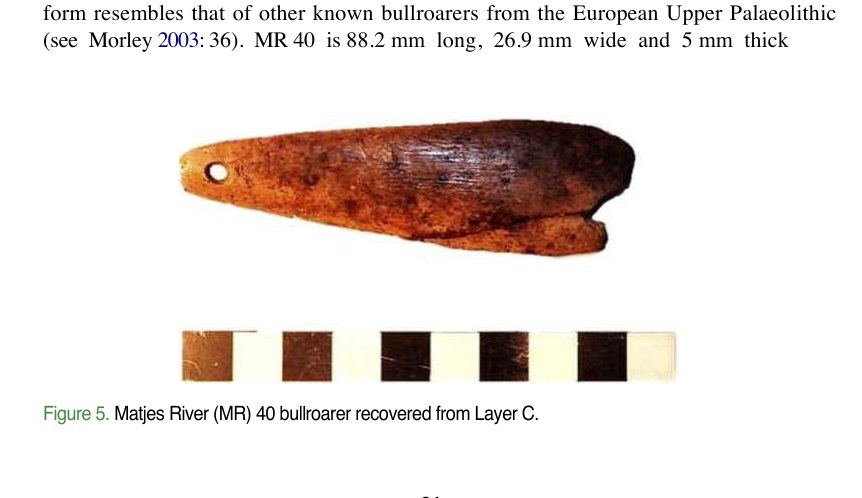
- Grave “pendants” have flipped before: MR 40 of Matjes River, a decorated pear-shaped bone from a shelter holding some 120 dead, whirred in replica within the bullroarer’s range and carries spin-wear on its hole. At Chahai, roarer-form jade blades lie at the neck, chest and waist of the dead, filed for eighty years as dress ornaments.
- The reading the plaques wore longest — records of the ancestors — is the bullroarer’s own job description: the whirled roar as the ancestors’ voice is the very reading prehistorians give Europe’s Magdalenian roarers. The ledger version was tested phylogenetically in 2014 and failed; what the test left standing is a lineage of copied designs.
- On the same soil the meaning never died: Portuguese elders forbade children to sound the whirring zuna at harvest, lest it disturb the souls of the dead.
A blade on the chest of the dead
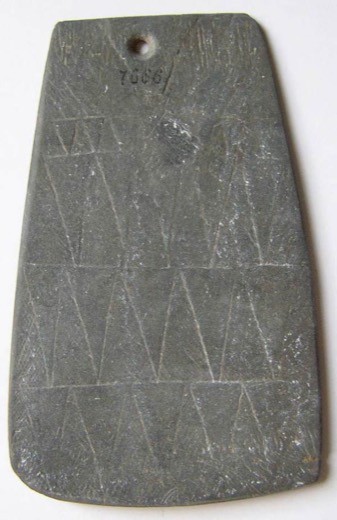
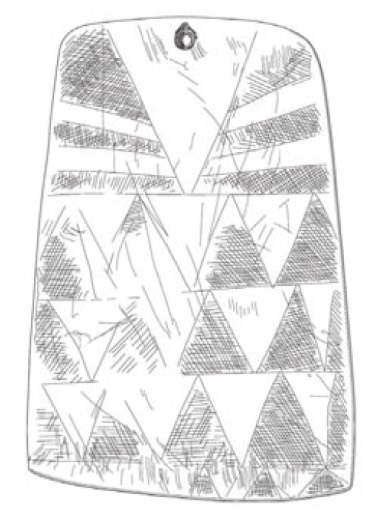
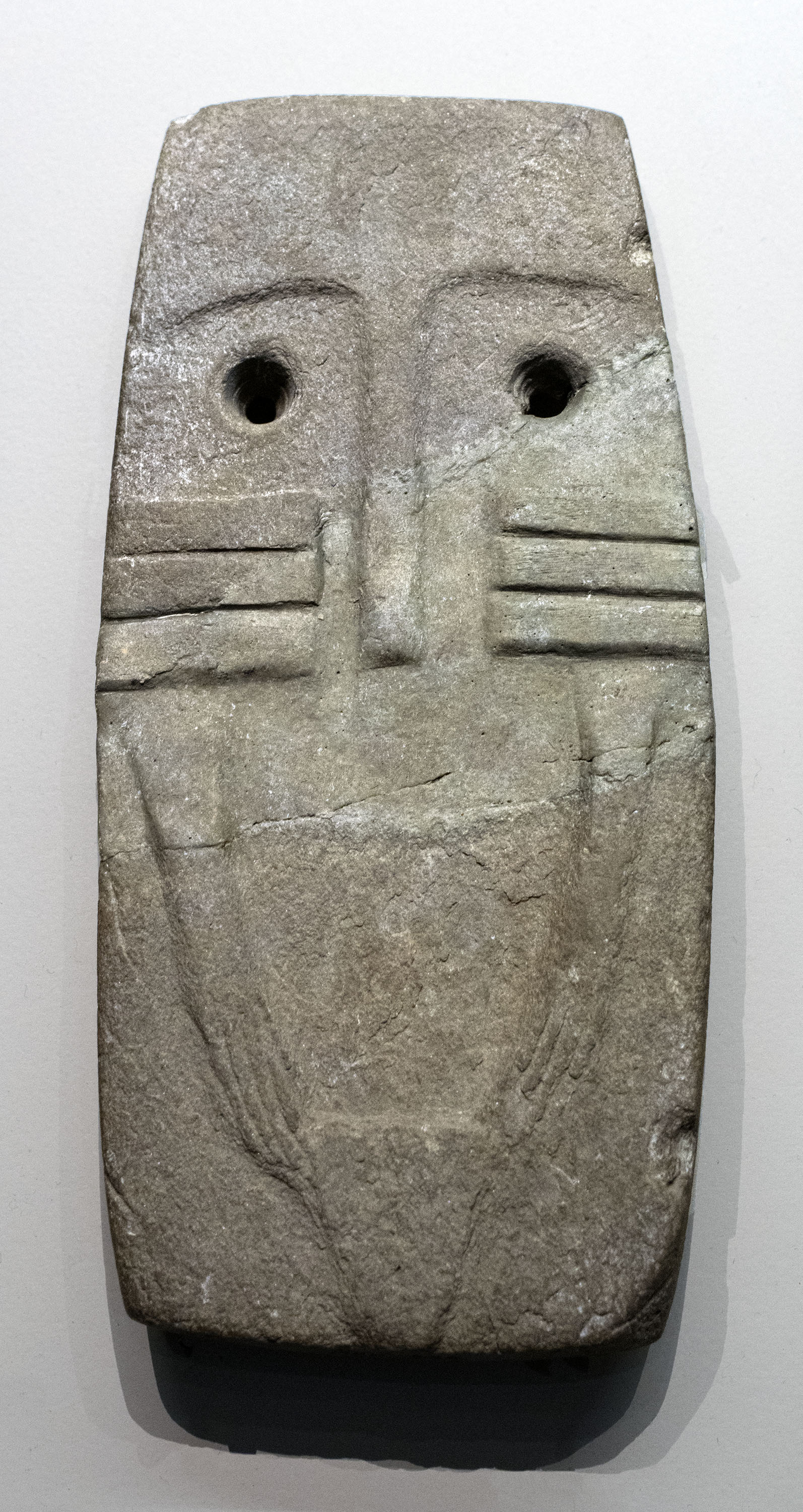
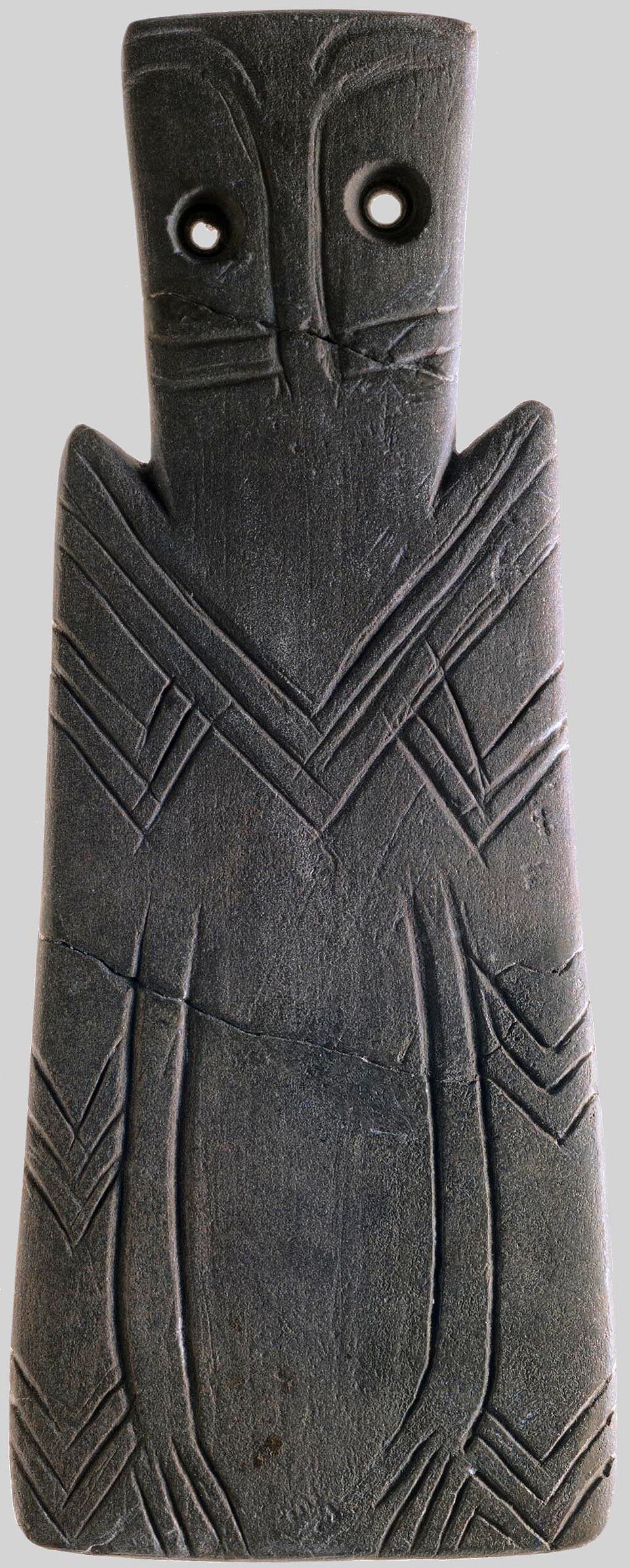
The plaques are among the most abundant ritual objects of European prehistory. From roughly 3500 to 2500 BCE the communities of the Alentejo, the Algarve and neighbouring Spain cut thin plates of slate and schist, ten to twenty centimetres long and about a centimetre thick, drilled a biconical hole through the narrow top end, and incised the faces with chevrons, filled triangles, chequers and zigzag bands. Some carry a pair of round staring eyes above the geometry — the famous “owl” type. Then they buried them with their dead, characteristically on the body, in the megalithic tombs and rock-cut caves of the southwest. More than two thousand survive, enough that a single registry has been built to hold them all.
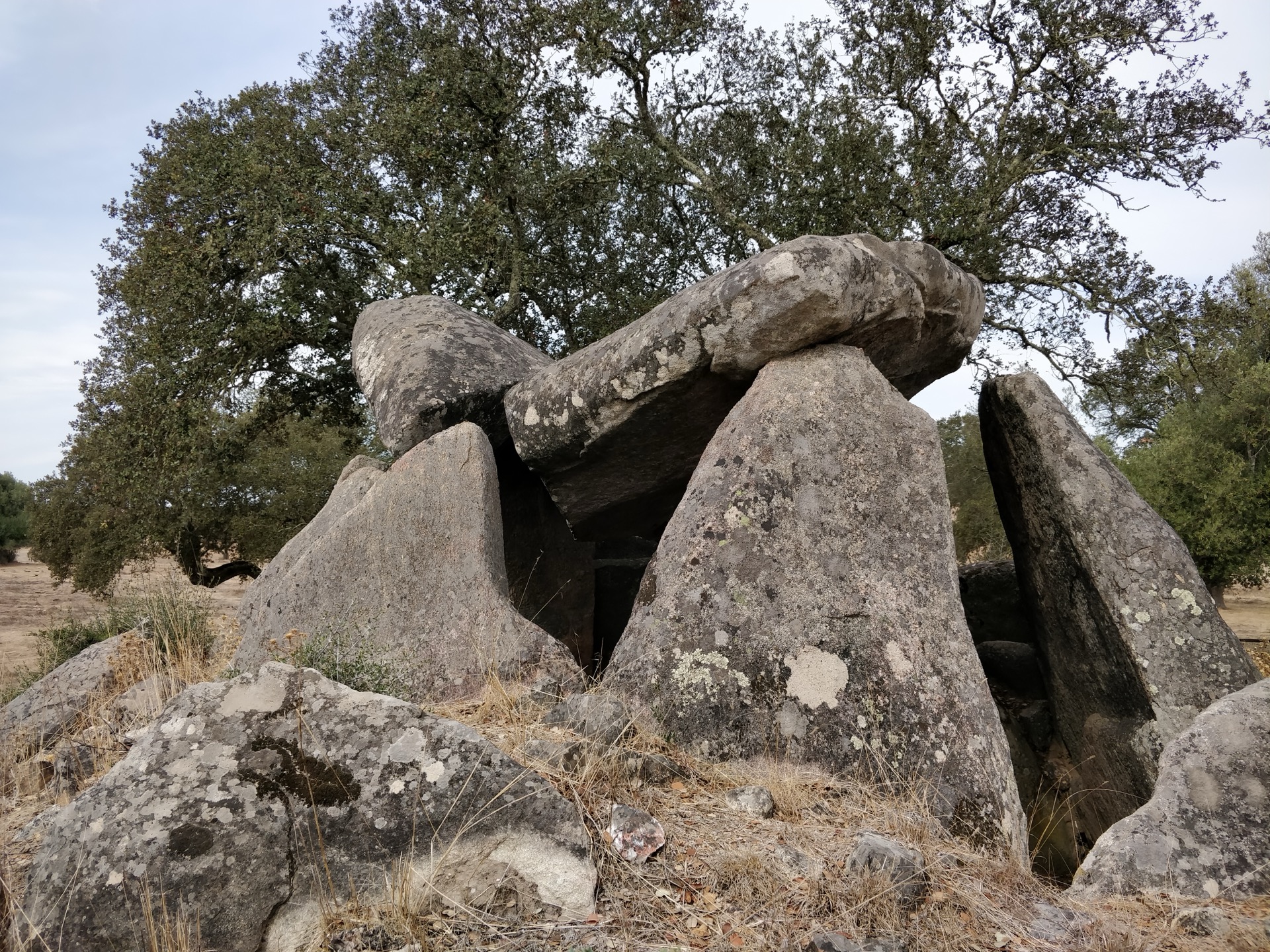
What they were for has been argued since the nineteenth century: mother-goddess idols, protective amulets, and most influentially Katina Lillios’s reading of them as memory-objects of the dead — heraldic markers of lineage, perhaps genealogical records whose engraved registers could be counted like a ledger. The countable version of that idea was put to a formal test in 2014, when Daniel García Rivero and Michael O’Brien ran a phylogenetic analysis of the engraved designs. The ledger failed the test. What the analysis found instead is in its way more remarkable: the designs behave like a lineage — motifs copied, varied and handed down from workshop to workshop, descent with modification written in stone. The plaques are not a record of ancestors. They are a line of descendants. The question a century of argument never asked is: descendants of what?
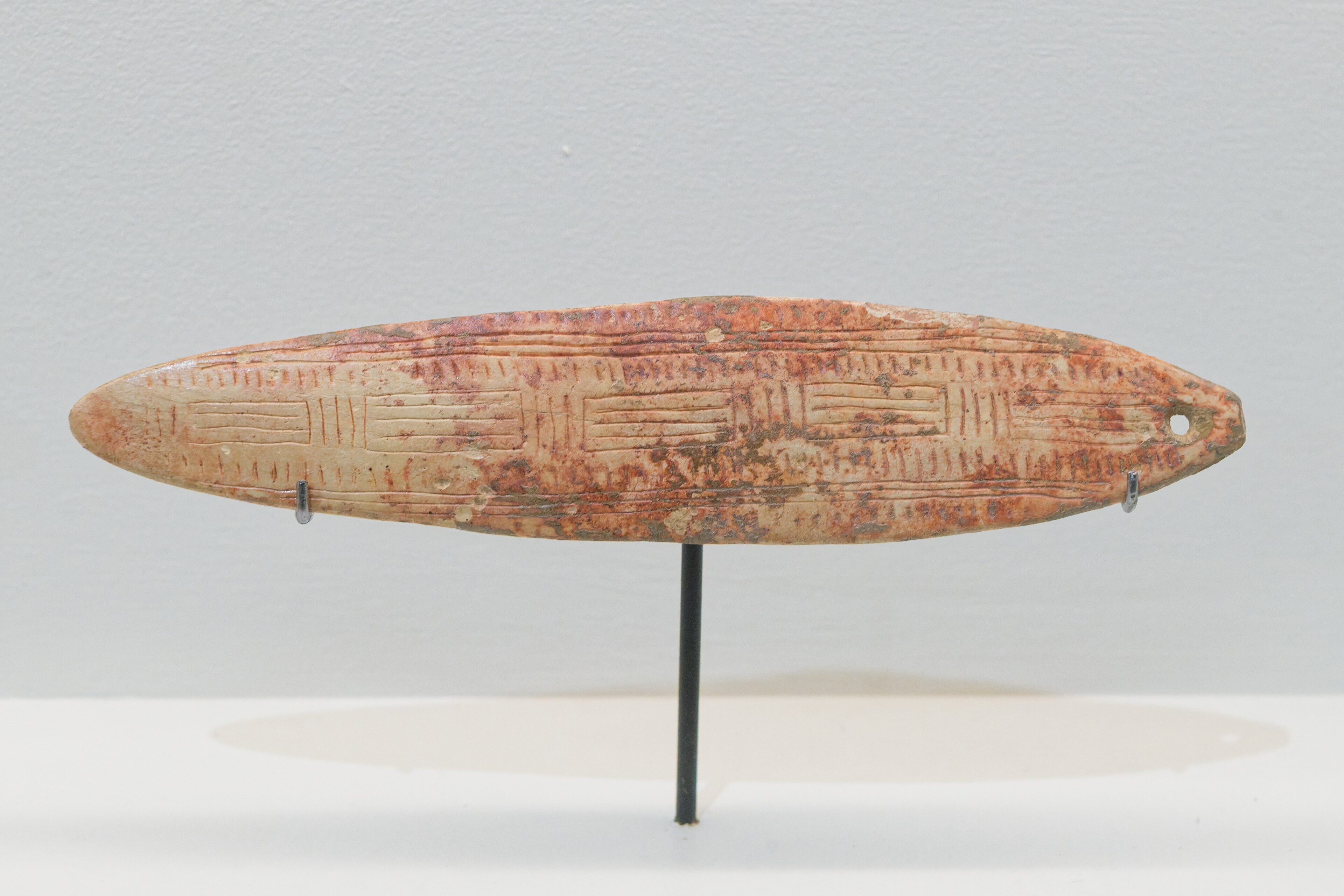
Set one beside the atlas and the answer is waiting. A thin blade, pierced by a single hole at the extreme top end, engraved with a geometric field, found in the company of the dead: outside Iberia, that description is a bullroarer’s. It is the description of the ochred antler roarer of La Roche de Birol, of the engraved bone roarers of Lortet, of the shale blade of Tuv, of the decorated bone from the Matjes River burials, of the jade blades on the chests of the Chahai dead. Every element the plaque-makers held constant for a thousand years — the blade plan, the stone, the top-end hole, the incised field, the company of the dead — is a bullroarer trait. And the hole is the tell. A pendant’s hole can sit anywhere its maker likes; an instrument’s cannot. The cord that spins a blade must pull from the extreme end of its long axis, and that is where two thousand plaques carry it — drilled, biconically, from both faces, the way a careful maker keeps a stone perforation from starting a crack.
The engraved roarers came first
The plaques did not appear in a Europe innocent of the instrument. Some eight thousand years before the first Alentejo tomb was sealed, a Magdalenian craftsman in the Dordogne shaped a slip of reindeer antler into a slender blade — a fish without a tail — drilled it for a cord, painted it with red ochre, and incised it with neat ranks of parallel lines and dots. Denis Peyrony, publishing the piece from La Roche de Birol in 1930, recognized “an instrument identical to the one certain Australian natives call a churinga” — the bullroarer — and the Abbé Breuil pronounced it the first complete Magdalenian “churinga” ever found. The identification has held against every sceptic: even André Leroi-Gourhan, the one dissenter of stature, conceded that a replica “behaves like a bullroarer” when swung, and when Michel Dauvois put a copy on a cord and recorded it, the voice came back — a fundamental sweeping from 35 to 205 hertz with every revolution.
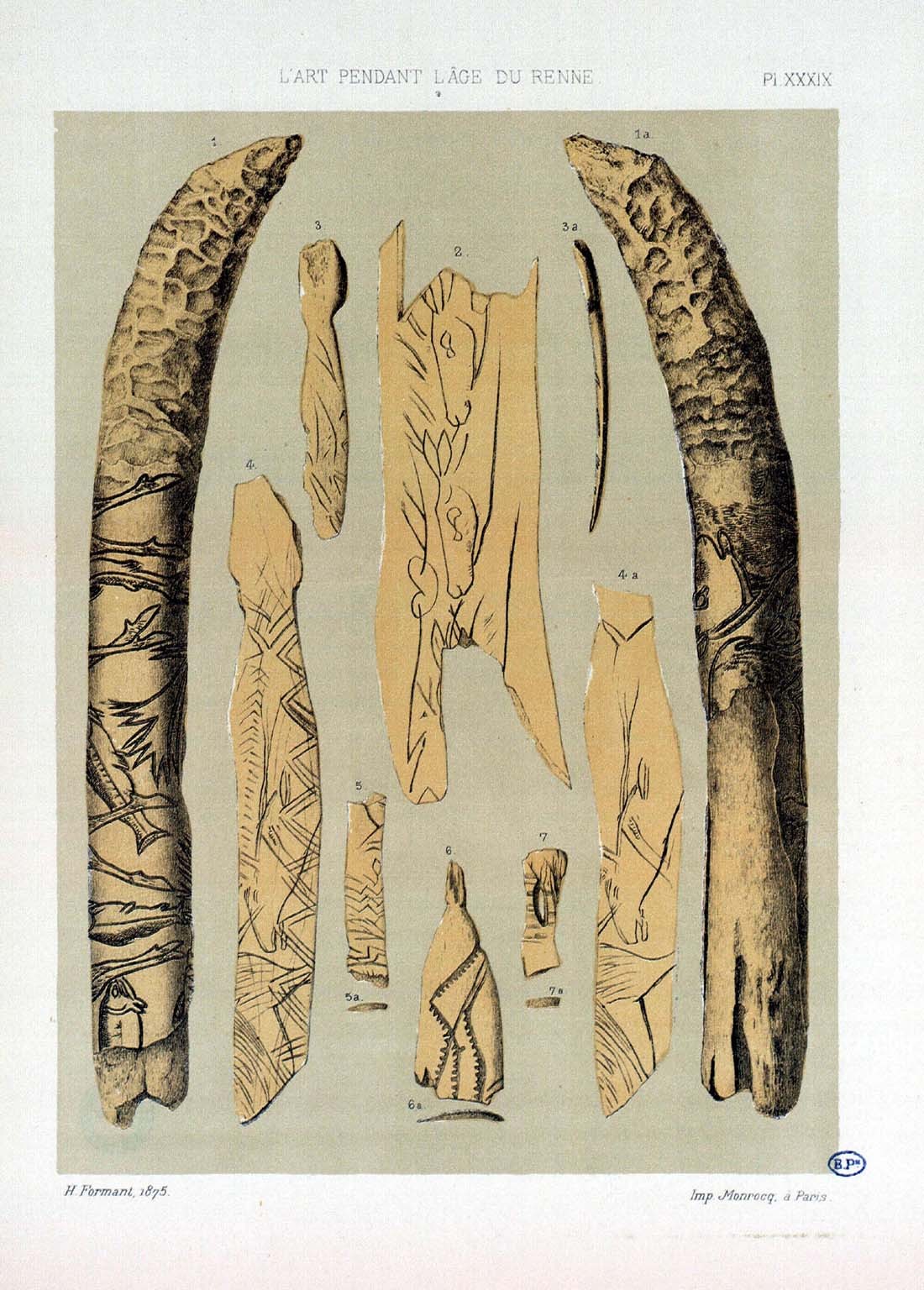
Nor was it alone. From the Grotte de Lortet in the Hautes-Pyrénées — the mountains at Iberia’s door — Édouard Piette recovered six more: thin, elongated blades of rib bone, pierced at one end for a cord, five of the six engraved. They anchor a corpus of several dozen Magdalenian bone and antler roarers, and reviewing that corpus Barandiarán set down the interpretation the field has leaned on since: the whirled roar as the voice of the ancestors, a voice the Magdalenian hunters expected to hear resound through their ceremonies.
Hold that phrase against the plaques. The voice of the ancestors: it is the same reading, the same intuition, that a century of Iberian scholarship reached for when it called the plaques ancestor-images and memory-objects of the dead — reached for without ever noticing that the object it was describing already had a sounding form in the caves of the Dordogne and the Pyrenees, engraved and end-pierced in just the same way. The peninsula’s prehistorians and the bullroarer’s ethnographers have been describing one artifact from its two ends. One tradition heard it; the other found it lying still, and mistook stillness for silence.
Stone sings
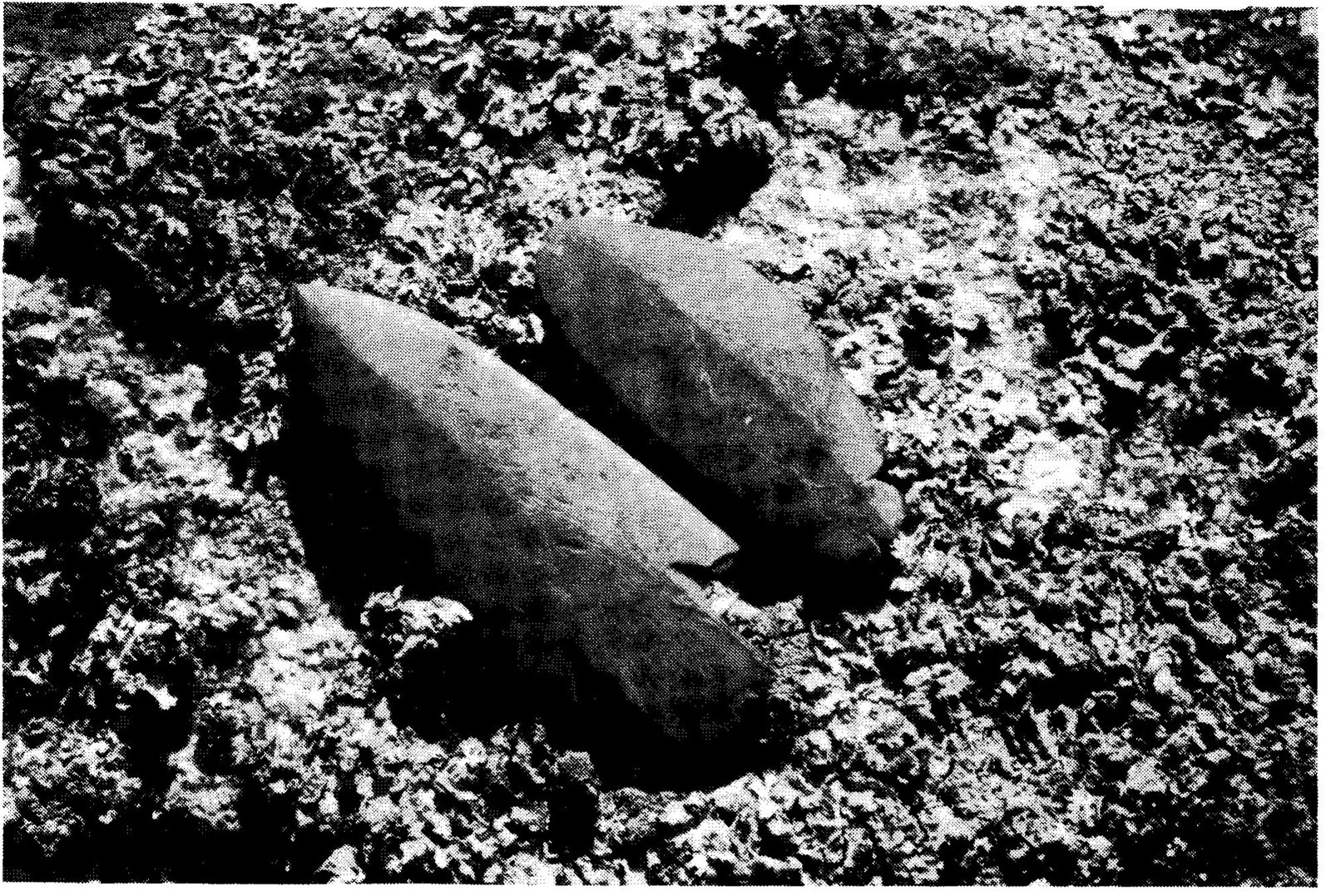
The instinctive objection is the stone: surely a bullroarer is a shepherd’s slat of wood, long and narrow as a knife, and a plate of slate could never be one. The northern end of the plaques’ own millennium answers it. In the spring of 1991, excavators at Tuv on the Saltstraumen tidal strait in northern Norway lifted a reddish-brown shale blade from a Stone Age layer dated to roughly 3500–5000 BCE: 6.4 cm long, 2.7 cm wide, nine grams, worked at one end to take a line. The field archaeologist in charge, Hein Bjartmann Bjerck, wondered first whether he had a knife blade or a piece of jewellery — the plaques’ own historiography in miniature — then fastened a fishing line to it and swung it.
“It was a fantastic experience to hear the shrill, powerful sound that was made.” — Hein Bjartmann Bjerck on the Tuv blade, reported in Cajsa S. Lund, “What is wrong with music archaeology?” (1998)
Note the proportions. The Tuv blade is barely two and a half times as long as it is wide — squatter in plan than many an Iberian plaque — and it screamed. The textbook aspect ratios of five-to-one and beyond describe the carpentered wooden slat of the ethnographic present; the stone and bone whirrers of prehistory keep breaking that rule and sounding anyway. Replicated bone “pendants” from the southern Cape, one of them frankly pear-shaped, sustain a pulsing whir between about 55 and 250 Hz; roarer slats speak at four millimetres of thickness, exactly the low end of the plaques’ centimetre. In length, in thickness, in material, in the count and placement of the hole, the plaque corpus sits inside the instrument’s attested world. And a corpus of two thousand is a distribution, not an object: alongside the broad chest-pieces it holds narrow, light, thin-bladed examples — the working end of the family.
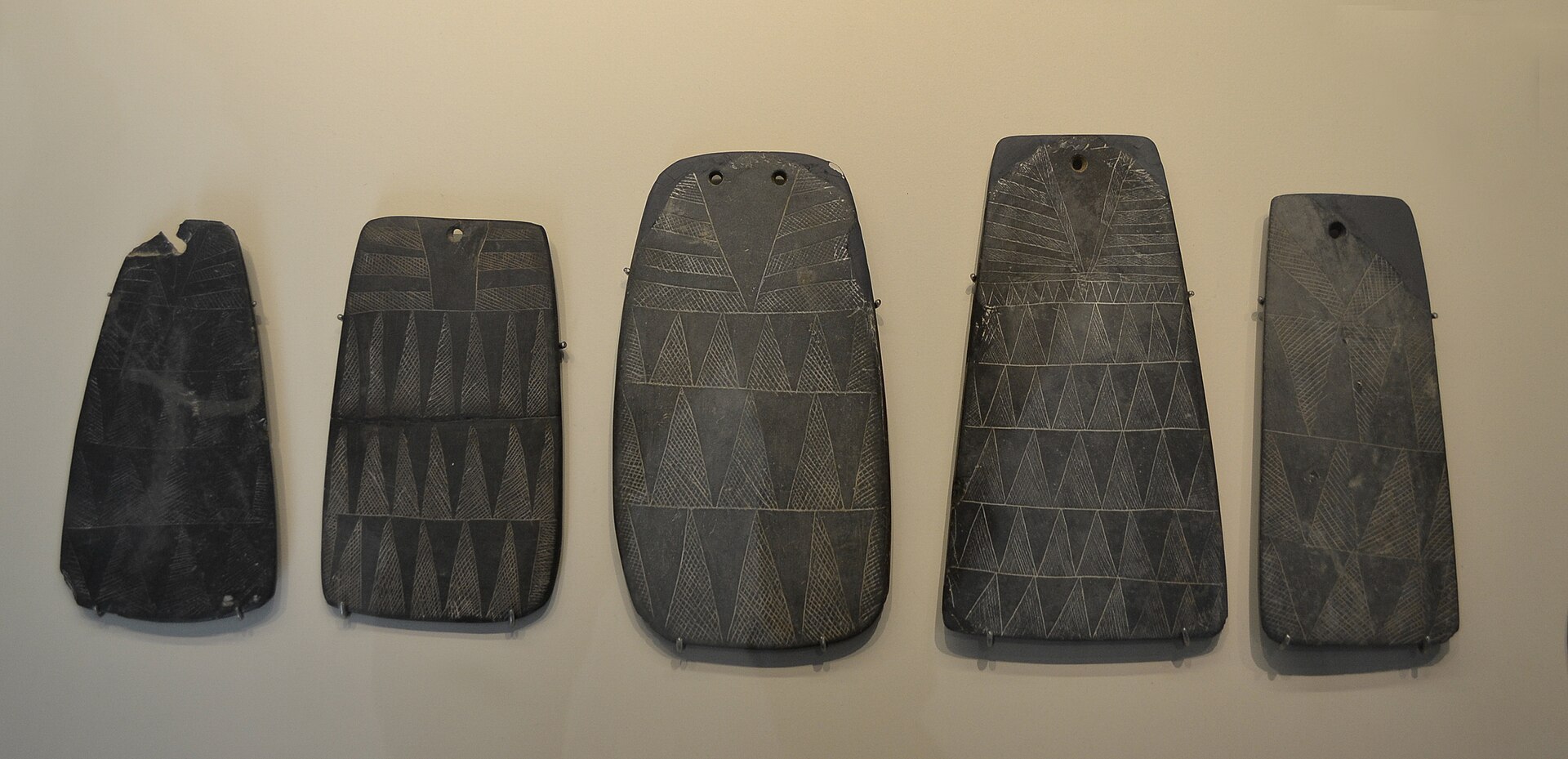
The heaviest plaques, it is true, would make unhandy instruments — a chest-piece of three hundred grams asks a great deal of a cord and more of a wrist. But that is precisely what descent explains. These are grave-goods: blades made for the tomb, in the instrument’s image, by communities translating a swung thing into a laid thing. A funerary form is under no obligation to fly, any more than the model boat in an Egyptian tomb is obliged to float. What it is obliged to do is keep the signature — and the signature, down to the placement of a hole that a static plaque has no working need of, is what a thousand years of plaque-makers refused to change.
The pendants that flipped
There is a use-wear literature on the plaques’ perforations, and it reports what anyone who accepts the descent would predict: the holes are worn by a cord, in suspension. The cord is half the instrument. A bullroarer between rites hangs, is worn, is carried on its string; a funerary blade laid on a body was never going to carry flight-wear at all. What the suspension wear actually establishes is that every plaque lived its life attached to a cord at the top of a blade — the instrument’s rigging, kept to the end.
And the recent history of exactly this kind of object counsels against letting a “pendant” label stand unspun. For decades MR 40 sat in the Matjes River collection as a decorated bone pendant from a rock shelter so dense with graves that it yielded some 120 people. In 2019 Joshua Kumbani and his colleagues made replicas, spun them mechanically for fifteen hours in a sound studio, and matched the wear patterns against the originals: spinning abrades one side of the perforation, hanging abrades its upper edge. MR 40 — pear-shaped, 88 mm, ochre still clinging to it — carried the spin signature, and its replicas whirred in the bullroarer’s range. A pendant from a place of burials became an instrument overnight.
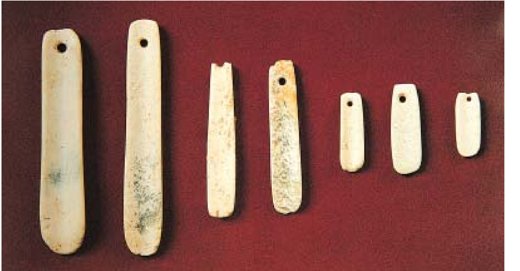
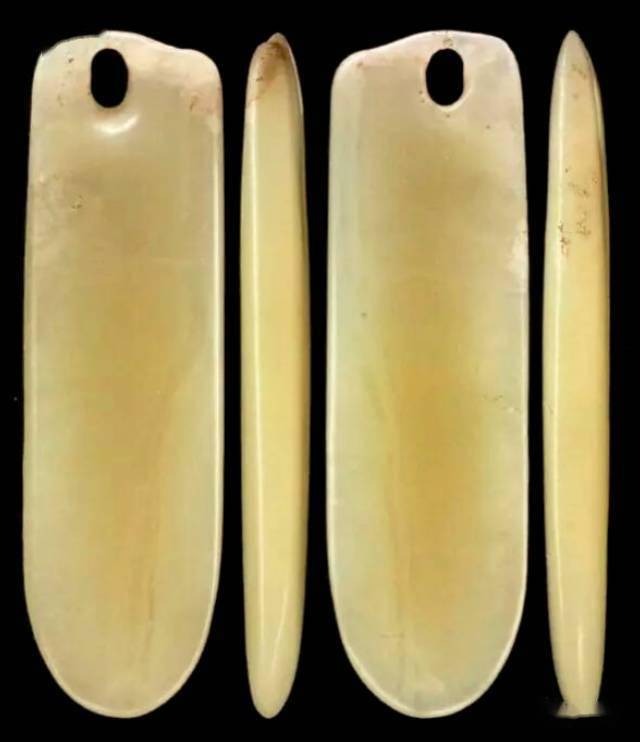
Half a world east, at Chahai and Xinglongwa in northeast China, the commonest jade objects of an 8,000-year-old culture are thin tongue-shaped blades, ground to a slender lens and pierced through one end — lying at the neck, chest and waist of the dead, in one house burial as three matched pairs of descending size, filed since discovery as dress ornaments while wearing the bullroarer’s outline exactly. The Iberian plaques are the largest and most elaborated member of this scattered family: blades that went into the ground with the dead on every continent where the trail runs, and came out of it labelled jewellery. Every member of the family that has been put to the acoustic test has found its voice.
The voice the peninsula kept
If the plaques are the bullroarer’s funerary line, Iberia should also show the living line — and it does, unbroken into the twentieth century. Across the plaques’ own peninsula the whirring blade never stopped: the brunzidor of Navarre, the Basque Country and Aragon; the Basque shepherds’ furrunfarra, a thin toothed board carved with the cross of helical commas — the sign, Servier writes, of celestial motion; the Portuguese zuna, cut by children in the Beira Baixa from the withe of old baskets and whirled on a string until it buzzed, its name from zunir, to drone.
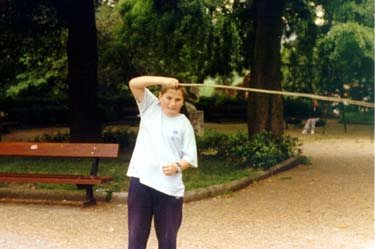
And it is the zuna that carries the old meaning to the door of the tombs. In Portugal, Jean Servier recorded, the elders forbade children to sound their zunas at harvest time, for fear the buzzing would disturb the souls of the dead, who were thought ready to leave the earth just as the crops came in. Set the two Portuguese customs side by side. In the Copper Age, the silent blade is laid on the chest of the dead; in the ethnographic present, the sounding blade is silenced for the sake of the dead. Five thousand years apart, on the same soil, they are one belief: the whirring blade belongs to the dead, and its sound reaches them. A prohibition of that shape does not attach itself to a child’s toy by accident. It is the residue of the instrument the toy descends from — the same long demotion from god’s voice to plaything that the atlas documents on every continent, with the taboo outliving the rite that made it.
What the plaques laid down
Read the plaques as bullroarers at rest and every stubborn fact of the corpus falls into order. The blade plan and the stone: the instrument’s, proven at Tuv in the same millennium. The single hole at the top end: the cord’s anchorage, kept in the one position only an instrument requires. The suspension wear: the rigging of a corded object that hung when it did not fly. The engraved field: the marked skin the roarer has worn since the Magdalenian caves. The placement on the body of the dead: the position of the Chahai blades, the context of the Matjes River burials. The drift toward broad, heavy, unflyable forms: descent with modification in a funerary line freed from flight — exactly the copied-and-varied lineage the phylogenetic analysis found in the designs.
And the meaning Iberian scholarship kept circling — ancestors, memory, the presence of the dead — is the meaning the bullroarer has carried wherever it has been heard: the voice of the ancestors, from the Magdalenian corpus to the harvest fields of the Beira Baixa, where the blade must fall silent so the souls of the dead can pass.
No rival reading covers the whole signature. Heraldry explains the dead but not the hole; the pendant explains the hole but not the blade-plan, the wear, or the graves; the idol explains none of the geometry that a thousand years of makers would not surrender. One ancestry explains all of it, and it was hanging in the museum cases the whole time. The mourners of the Alentejo did not invent a new object to lay on their dead. They took the oldest voice in Europe — the engraved blade that had spoken for the ancestors since the ice — cut it in the stone that sings, and gave it back to the ancestors: at rest on the chest, its cord-hole waiting, where no living hand could swing it. The plaques are not a puzzle beside the bullroarer’s story. They are a chapter of it — the chapter in which the instrument lies down with its owners.
Key sources
- Lillios, K. T., Heraldry for the Dead: Memory, Identity, and the Engraved Stone Plaques of Neolithic Iberia (University of Texas Press, 2008); and “Lives of Stone, Lives of People: Re-Viewing the Engraved Plaques of Late Neolithic and Copper Age Iberia,” European Journal of Archaeology 7(2), 2004, pp. 125–158 — corpus, chronology, funerary contexts, and the memory-object reading.
- ESPRIT — Engraved Stone Plaque Registry and Inquiry Tool, University of Iowa: iberian.its.uiowa.edu — the plaque corpus and images.
- García Rivero, D. & O’Brien, M. J., “Phylogenetic Analysis Shows That Neolithic Slate Plaques from the Southwestern Iberian Peninsula Are Not Genealogical Recording Systems,” PLOS ONE 9(2), 2014, e88296 — the ledger test, and the descent-with-modification structure of the designs.
- Woods, A. & Lillios, K. T., experimental use-wear replication of plaque perforations (2006) — cord-suspension wear on the holes.
- Lund, C. S., “What is wrong with music archaeology?” (1998) — the Tuv find, its dimensions, and Bjerck’s field test; see the Tuv record.
- Peyrony, D. (1930) on La Roche de Birol, with Dauvois’s replica acoustics (35–205 Hz) and Leroi-Gourhan’s concession; Chollot, M. (1964) and Barandiarán on the Lortet corpus and the ancestors’-voice reading; see the La Roche de Birol and Lortet records.
- Kumbani, J., et al. (2019), replica spinning and use-wear analysis of the southern Cape Later Stone Age material — MR 40, the spin-wear criterion, and the 55–250 Hz range; see the Matjes River record.
- Servier, J., 1970 survey — the Portuguese zuna harvest prohibition and the Iberian shepherds’ roarers; see the zuna and brunzidor records.
- As far as we know, the identification of the Iberian slate plaques as the bullroarer’s funerary descendants is original to this page.